

Which Theater Form Features Elaborate Staging And Makeup?


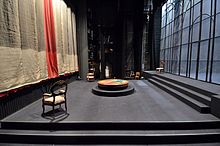
In theatre and performing arts, the stage (sometimes referred to as the deck in stagecraft) is a designated space for the performance of productions. The phase serves as a space for actors or performers and a focal point (the screen in cinema theaters) for the audience. Equally an architectural feature, the stage may consist of a platform (often raised) or serial of platforms. In some cases, these may be temporary or adjustable but in theaters and other buildings devoted to such productions, the stage is often a permanent feature.
There are several types of stages that vary as to the usage and the relation of the audition to them.[1] The near common class found in the West is the proscenium stage. In this type, the audience is located on one side of the phase with the remaining sides subconscious and used past the performers and technicians. Thrust stages may be similar to proscenium stages but with a platform or performance area that extends into the audition space so that the audience is located on three sides. In theatre in the circular, the audience is located on all 4 sides of the stage. The fourth type of stage incorporates created and constitute stages which may be constructed specifically for a operation or may involve a space that is adapted as a stage.
Types of staging [edit]
Proscenium stage [edit]
Since the Italian Renaissance, the most common stage used in the Due west has been the proscenium stage which may also be referred to equally a moving-picture show frame stage. The primary feature is a big opening known as the proscenium curvation through which the audience views the performance. The audition directly faces the phase—which is typically raised several feet higher up front row audition level—and views only 1 side of the scene. This one side is commonly known as the invisible quaternary wall of the scene. The proscenium arch evolved from the proskenium in Aboriginal Greek theaters. This was the space in front of the skênê or properties where the actors actually played.
The first indoor theatres were created in French tennis courts and Italian Renaissance palaces where the newly embraced principles of perspective immune designers to create stunning vistas with buildings and copse decreasing in size toward a "vanishing betoken" on the horizon. Stage floors were raked upward slightly from front to back in social club to contribute to the perspective illusion and also to brand actors more visible to audiences, who were seated on level floors. After, audience seating was raked, and balconies were added to give audiences a fuller view. By the end of the 19th century, most stages had level floors, and much of the audition looked down on, rather than up to, the stage.
The competition among royals to produce elegant and elaborate entertainments fueled and financed the expansion of European court theatres. The proscenium—which often was extremely decorative in the manner of a triumphal curvation—"framed" the prospective movie. The want of courtroom painters to show more than i of their perspective backgrounds led court architects to accommodate the pin-rails and pulleys of sailing ships to the unrolling, and later to the lowering and raising, of canvas backdrops. A wood (and later steel) grid above the stage supported pulleys from which wooden battens, and later steel pipes, rolled downward, or descended, with attached scenery pieces. The weight of heavy pieces was counterbalanced by sandbags. This organisation required the creation of a storage stage house or loft that was normally as loftier or higher than the proscenium itself. A "full-wing" phase could store the entire height of scenery above the visible stage using the pin-rails before or during performance, whereas a "half-fly" stage (common in smaller locations) could merely store props of limited size and thus required more careful backdrop and scenery pattern. Theatres using these rope systems, which are manually operated past stagehands, are known as hemp houses. They accept been largely supplanted by counterweight wing systems.
The proscenium, in conjunction with stage curtains chosen legs, conceals the sides of the stage, which are known as the wings. The wings may be used by theatre personnel during performances and as storage spaces for scenery and theatrical properties. Several rows of short curtains beyond the acme of the stage, called teasers, hibernate the backdrops, which in turn are hidden above the stage in the fly organisation loft until ready for use.
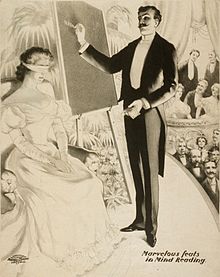
A mentalist on a stage apron in a mind-reading functioning, 1900
Often, a phase may extend in front end of the proscenium arch which offers additional playing surface area to the actors. This area is referred to equally the apron. Underneath and in front of the apron is sometimes an orchestra pit which is used by musicians during musicals and operas. The orchestra pit may sometimes be covered and used equally an boosted playing space in guild to bring the actors closer to the audience. The stage is often raised higher than the audition. Infinite higher up some proscenium stages may include a flyloft where defunction, scenery, and battens supporting a variety of lighting instruments may hang.
The numerous advantages of the proscenium stage accept led to its popularity in the West. Many theatrical properties and scenery may be utilized. Backdrops, curtains and lighting tin exist used to greater effect without risk of rigging being visible to the audition. Entrances and exits tin can exist fabricated more svelte; surprise becomes possible. The actors merely have to concentrate on playing to the audition in one management.
Boxes are a feature of more modernistic stage designs in which temporary walls are built inside any proscenium stage, at a slight angle to the original walls, in lodge to allow audience members located to the left or right of the proscenium (the further out, the larger the angle) to encounter the entirety of the phase.[ commendation needed ] They enable the creation of rat runs[ description needed ] around the back of the stage, which are when cast members have to walk between entrances and exits without existence seen by the audience.
Theatre in the circular [edit]
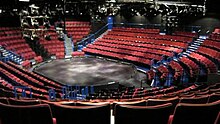
This type of stage is located in the middle of the audience, with the audience facing it from all sides. The audience is placed shut to the action, which provides a feeling of intimacy and involvement.
In-the-round stages crave special considerations in production, such as:
- Scenery that does not obscure actors and the residual of the phase from parts of the audition.
- Backdrops and curtains cannot be used, thus the director must find other ways to set the scene.
- Lighting design is more difficult than for a proscenium stage, since the actor must be lit from all sides without blinding nearby audience members.
- Entrances and exits must be made either through the audience, making surprise entrances very difficult, or via closed-off walkways, which must be inconspicuous. As a result, stage entrances are normally in the corners of the theatre.
- The actors need to ensure that they do not have their backs turned to any part of the audition for long periods of time, in lodge to be seen and heard clearly.
Thrust stage [edit]

A thrust phase at the Pasant Theatre
A thrust stage is 1 that extends into the audience on three sides and is connected to the backstage area by its upstage terminate. A thrust has the benefit of greater intimacy between the audience and performers than a proscenium while retaining the utility of a backstage area. Entrances onto a thrust are most readily made from backstage, although some theatres provide for performers to enter through the audience using vomitory entrances. An arena, exposed on all sides to the audience, is without a backstage and relies entirely on entrances in the house or from under the phase.
As with an arena, the audience in a thrust stage theatre may view the phase from three or more than sides. If a performance employs the fourth wall, that imaginary wall must be maintained on multiple sides. Like to theatre in the round, the audience can view the operation from a variety of perspectives, and equally such information technology is usual for the blocking, props and scenery to receive thorough consideration to ensure that no perspective is blocked from view. A loftier backed chair, for instance, when placed stage correct, could create a blind spot in the stage left action.
Black box [edit]
A black box theater consists of a uncomplicated yet somewhat unadorned performance infinite, ideally a large square room with black walls and a apartment flooring, which tin can be used flexibly to create a stage and audience area.
Created and found spaces [edit]
A stage can likewise be improvised wherever a suitable space can be found. Examples may include staging a performance in a non traditional infinite such equally a basement of a building, a side of a loma or, in the case of a busking troupe, the street. In a similar style, a makeshift stage tin exist created by modifying an environs. For example, demarcating the boundaries of a stage in an open space by laying a carpeting and arranging seating before information technology. The theater visitor Shakespeare In The Park, in fact, is based effectually performing Shakespeare plays in a space that one wouldn't likely find it, namely, Central Park in New York City.
Stage terminology [edit]
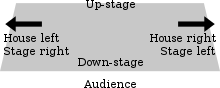
Firm correct/left are from the audience's perspective

The stage itself has been given named areas to facilitate the precise motility and positioning of actors on a stage (run into Blocking (stage)).
To an actor facing the audience, "left" and "right" are the reverse of what they are for the audience. To prevent confusion, actors and directors never utilise the unmarked terms left or correct for the sides of the phase. Rather, they use a phrase specifying the viewpoint. The terms "stage left" and "stage correct", respectively, denote the sides of the stage that are on the actor's left and right when the actor is facing the audition, while "house left" and "business firm right" are the opposite, denoting the sides of the stage as viewed by the audience. In Federal republic of germany, stage right and left are reversed, existence the director'due south view rather than the actor'due south.[ commendation needed ]
Less ambiguous terms used in theatres that follow a British tradition are "Prompt Side" or "P Side" (Stage left) and "Off-Prompt" or "O.P. Side" (Stage Right), relating to the traditional location of the Stage Manager.[2] In French, the terms "côté cour" (square side) for stage left and "côté jardin" (garden side) for stage right are used, in reference to the Théâtre des Tuileries.
Likewise, the meaning of "front" and "back" would be unclear because they depend on perspective. Instead, the term "upstage" is used to denote the office of the stage furthest from the audience or to motion abroad from the audition, while "downstage" denotes the portion of the phase closest to the audition or to motility in that direction. These terms were common in older theatres, which gave the audition a better view of the activity by inclining the floor (known as a raked stage), then upstage really was at a higher elevation than downstage.
A raked stage tin can vary in its incline; ten degrees is considered ideal[ by whom? ] for the audience and actor comfort. A dancing surface incline is often dissimilar from an acting incline and can vary from three degrees to twenty degrees.[ commendation needed ]
Scenographic theory [edit]
In relationship to approaches to scenography, Rachel Hann has proposed that there "are no stages without scenographics".[three] This is based on an statement that "all stages are likewise scenes",[four] which challenges the "deterministic assumption that stages precede scenography".[5] In this model, stages become manifest through the place orientating traits of scenographics (rather than the other way effectually). The implications of this are that all theatre is scenographic – even if it has no defined objects or 'setting' – as all theatre is performed on a stage. Hann summarises this position by using the hybrid 'stage-scene' when discussing the tensions between the histories of these practices, particularly with reference to original Greek skene as a physical tent or hut that ultimately shaped current conceptualizations of 'the phase'.
See also [edit]
- Noh stage, classical Japanese theater
References [edit]
- ^ "Theatre Types". ia470.com. Archived from the original on 2010-07-10.
- ^ "Archived copy" (PDF). Archived (PDF) from the original on 2016-07-05. Retrieved 2016-02-20 .
{{cite web}}: CS1 maint: archived copy equally title (link) - ^ Hann, Rachel (2019), Beyond Scenography, Oxon. and New York: Routledge, p. 78
- ^ Hann 2019, p. 3.
- ^ Hann 2010, p. 63. sfn error: no target: CITEREFHann2010 (assistance)
External links [edit]
 Media related to Stages at Wikimedia Commons

Which Theater Form Features Elaborate Staging And Makeup?,
Source: https://en.wikipedia.org/wiki/Stage_(theatre)
Posted by: pattisonminman.blogspot.com
0 Response to "Which Theater Form Features Elaborate Staging And Makeup?"
Post a Comment